




Jeep Cherokee Towing Capacity: Engines, Equipment and Trailer Tips
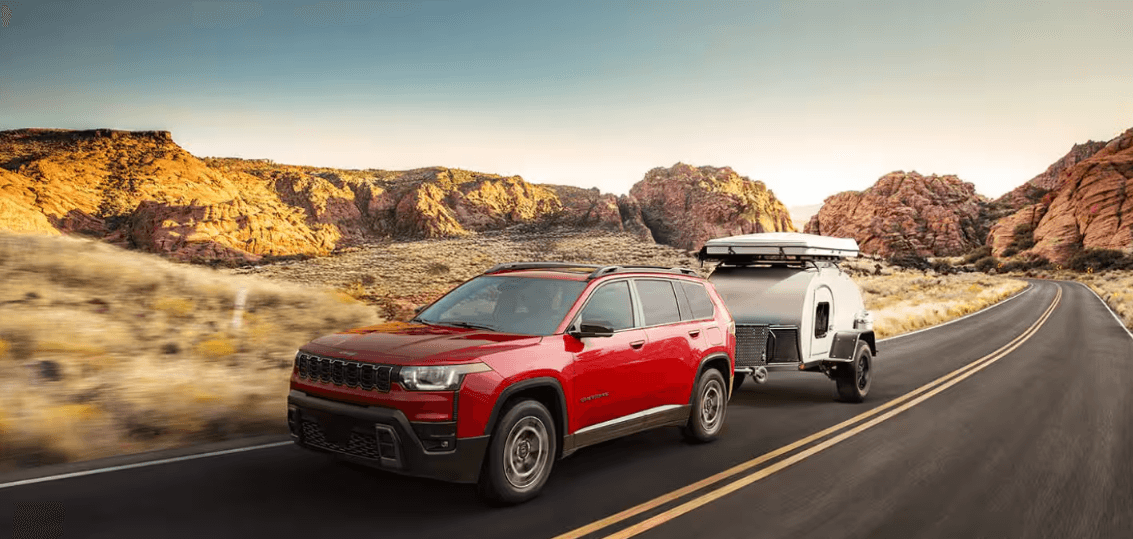
The Jeep® Cherokee is back, and it brings a towing number worth paying attention to: 3,500 lbs when properly equipped. Whether you’re hauling a boat or hitching up a camper for a weekend trip on regional highways, knowing your exact Jeep Cherokee towing capacity matters before you load anything behind it. This guide breaks down the engines, trims, and hardware that determine what your Cherokee can actually pull.
The All-New 2026 Jeep Cherokee: A Capable Return
Built on the STLA Large platform, the 2026 Cherokee is Jeep’s first non-plug-in hybrid in North America, pairing a self-charging turbo-hybrid powertrain with standard 4×4. There’s no plug and no charging stop, unlike the 4xe models Jeep has phased out. Jeep claims 37 mpg combined and a range of more than 500 miles on a tank.
Official 2026 Jeep Cherokee Towing Capacity
The 2026 Jeep Cherokee towing capacity tops out at 3,500 lbs, but only when the vehicle is properly equipped with the Trailer Tow Group. Jeep calls that rating unsurpassed in class, and it beats most compact crossover rivals, which typically max out between 1,500 and 2,700 lbs. The headline figure doesn’t apply to every Cherokee on the lot, though. GVWR is rated at 5,350 lbs against a curb weight of about 4,295 lbs on a Limited, and payload varies by trim and equipment. Those figures work together to define how much you can safely add, whether it’s passengers, cargo, or a trailer tongue pressing down on the hitch, so check the sticker on the vehicle you’re actually buying.
1.6L Turbo-Hybrid Engine and Drivetrain Considerations
Every 2026 Cherokee runs the 1.6L I4 Turbo Hybrid, which makes 177 hp and 221 lb-ft on its own and combines with two electric motors for a net 210 hp and 230 lb-ft, delivered through a CVT. Electric motors make their torque immediately, which is what helps the Cherokee get a loaded trailer moving without the engine straining.
Drivetrain-wise, Active Drive I 4×4 is standard on every trim, engaging the rear wheels when traction demands it and disconnecting when it doesn’t, alongside terrain modes for Auto, Sand, Snow, and Mud. Standard 4×4 adds grip when towing on wet boat ramps or gravel roads, though it doesn’t change the maximum rated capacity on its own.
Why Towing Capacity Depends on Exact Configuration
The 3,500-lb rating isn’t automatic just because you buy a Cherokee. It requires the Trailer Tow Group, and that package is only available on Laredo, Limited, and Overland trims. The base Cherokee 4×4 doesn’t offer the Trailer Tow Group at all, which means it tows well below the advertised maximum. If you’re comparing towing capacity across trims, always check whether the tow package is standard, optional, or unavailable. That single detail changes the number more than engine choice or drivetrain does.
Towing Capacity by Trim Level
Not all Cherokee trims are built the same when it comes to towing. Here’s how the lineup breaks down, along with a comparison of the specs that matter most.
Cherokee
The base Cherokee comes with 17-inch alloy wheels, LED reflector headlamps, heated mirrors, and cloth seats, along with a 10.1-inch Uconnect touchscreen and wireless Apple CarPlay and Android Auto. It’s a well-equipped daily driver, but since the Trailer Tow Group isn’t offered on this trim, it’s not the pick if towing is a priority. Plan on stepping up to Laredo or higher if you need to pull a trailer.
Laredo
The Laredo adds heated front seats, a 6-speaker audio system, 18-inch wheels, and remote start, and it’s the entry point for full towing capability. With the Trailer Tow Group added, Laredo buyers get access to the full 3,500-lb rating, matching the higher trims. For anyone shopping specifically for a Cherokee with a tow package at a lower price point, Laredo is worth a close look. It’s a trim we often point buyers toward when they want capability without paying for extra luxury features.
Limited
The Limited trim brings Deep-Tint Sunscreen Glass, a power liftgate, cargo-area LED lighting, and the upgraded Uconnect 5 system with a 12.3-inch touchscreen, 4G LTE Wi-Fi hotspot, and a wireless charging pad. Limited models hit the same 3,500-lb ceiling as Laredo and Overland once the Trailer Tow Group is added, so the upgrade here is comfort and tech, not towing muscle. An optional Limited Altitude blackout appearance package is available too, though it doesn’t affect towing numbers.
Overland
The Overland trim is built for drivers who tow often and want the terrain hardware to match. It includes 20-inch all-season tires, Active Drive I, and the full Selec-Terrain System, plus a 10.25-inch digital instrument cluster, Cognac stitching, and a universal garage-door opener.
The Trailer Tow Group on this trim includes Blind Spot with Trailer Detection, a Class III Receiver Hitch, a 7-and-4-pin wiring harness, and a compact spare tire. Buyers can also add the Advanced Pro Tech Group, which brings ventilated seats, a surround-view camera, and ParkSense for tighter parking situations with a trailer attached.
Understanding Weight Terms: Payload, Tongue Weight, and GCWR
A few terms come up constantly in towing conversations, and knowing them helps you avoid overloading your Cherokee. GVWR, or Gross Vehicle Weight Rating, is the most the Cherokee itself can weigh fully loaded, and Jeep rates it at 5,350 lbs. Subtract the curb weight and what’s left is your payload, meaning passengers, cargo, and the trailer’s tongue weight pressing down on the hitch.
GCWR, or Gross Combined Weight Rating, is a separate figure covering the Cherokee and the trailer together. Neither number should be exceeded, and the tongue weight of a loaded trailer counts against your payload before you’ve put a single person in the car. Your door-jamb sticker lists the figures for your specific build.
Tongue weight is the downward pressure the trailer puts on the hitch ball. It should stay between 10% and 15% of the trailer’s total weight. Too little causes sway at highway speeds; too much reduces your ability to steer confidently. Axle weight rating is another figure worth knowing, since it caps how much weight can sit on a single axle, and a loaded trailer should never exceed that per-axle limit.
Trailer Brakes and Hitch Equipment You’ll Need
A hitch setup involves more parts than most people expect: the hitch itself, a trailer ball, ball mount, trailer coupler, hitch pin, and an electrical receiver for lights and brakes. On the Overland trim, the Trailer Tow Group includes a Class III Receiver Hitch along with a 7-and-4-pin wiring harness, which covers most light-to-moderate trailers.
If you tow frequently or near the top of the rated capacity, a weight distribution hitch spreads tongue weight across both axles instead of concentrating it at the rear, improving handling. As trailer weight climbs closer to the 3,500-lb ceiling, a proportional brake controller becomes worth adding too. Electric trailer brakes need a compatible in-cabin controller and proper pre-wiring, so it’s worth confirming with our team exactly what’s included in your specific tow package before you assume your setup is brake-ready.
What You Can Realistically Tow with a 2026 Cherokee
A 3,500-lb rating puts the Cherokee near the top of the compact crossover class, well above most rivals in the 1,500 to 2,700-lb range. In practical terms, that capacity handles small utility trailers, single-axle pop-up campers, light travel trailers, a pair of personal watercraft, or a snowmobile and gear trailer. A Cherokee can tow a camper, as long as it’s a lightweight, single-axle model within the rated limit.
What it’s not built for is large travel trailers, enclosed car haulers, or heavy multi-axle setups. If your towing needs run heavier, the Grand Cherokee is worth a look, with a best-in-class rating of 6,200 lbs when paired with the 2.0L Hurricane 4 Turbo engine. We often walk customers through both models side by side, since matching the right SUV to the right trailer weight beats sticking with one badge out of habit. You can browse our new Jeep lineup to compare the Cherokee and Grand Cherokee directly.
Tips for Safe, Confident Towing
Towing with a Jeep Cherokee comes down to preparation as much as horsepower. Before any trip, whether it’s a boat launch on a local lake or a highway run with a camper, run through a quick pre-tow inspection. Check tire pressure on both the Cherokee and the trailer, since underinflated tires reduce stability and fuel economy. Torque-check the hitch connection to make sure nothing has loosened since the last trip. Test the brake controller so you know the trailer brakes engage properly before you’re on the road. And check your mirrors and adjust for trailer width, especially if you’ve added towing mirrors or extensions.
Beyond the checklist, keep speeds moderate, increase following distance, and get familiar with how the Cherokee handles with a loaded trailer before hitting highway speeds. If you’re new to towing with a Jeep Cherokee, practicing in an empty parking lot first can build confidence before you’re merging onto US-224.
Confirm Your Cherokee’s Towing Specs with Findlay Chrysler Dodge Jeep Ram
Check Your Exact Rating
Every number in this guide reflects Jeep’s published specs, but your specific Cherokee’s exact rating depends on its individual build. The door-jamb sticker on your vehicle lists the precise GVWR, payload, and towing figures for that VIN, and it’s always worth double-checking before you hook up a trailer for the first time.
Get Help from Findlay
If you have questions about which trim fits your towing needs, our service and sales teams at Findlay Chrysler Dodge Jeep Ram are happy to walk through the details with you. Check out our current Jeep specials or stop by our location at 10305 US-224 in Findlay, Ohio, to see the 2026 Cherokee lineup in person and get help matching a configuration to whatever you’re planning to tow this season.
0 comment(s) so far on Jeep Cherokee Towing Capacity: Engines, Equipment and Trailer Tips