





Ram 1500 Towing Capacity Guide: What Ohio Truck Shoppers Should Know
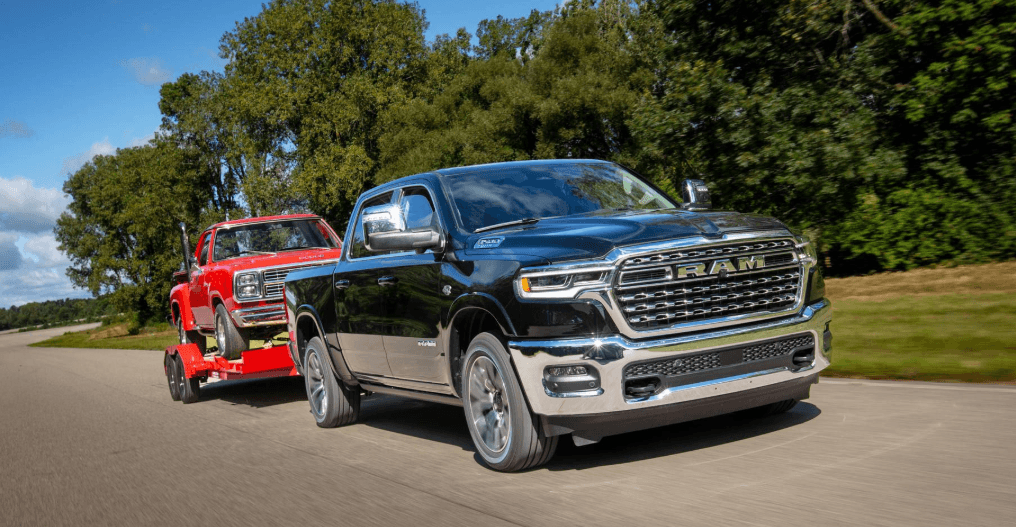
Ram 1500 towing capacity isn’t a single number you can circle in a brochure. It shifts based on engine, cab, bed length, drivetrain, and axle ratio, and the exact figure for your truck depends on how all those pieces come together. Maybe you’re pulling a boat out of Lake Erie, or hauling a camper to Hocking Hills, or moving landscaping equipment around Findlay, Ohio. Understanding these variables saves you from guessing. Browse our new Ram inventory to see current configurations, or keep reading to learn how to match a Ram 1500 to your specific towing job.
Why Ram 1500 Towing Capacity Isn’t One Simple Number
Ram publishes a range for Ram 1500 max towing capacity, but that top figure only applies to one specific build. Change the engine, swap the axle ratio, or add four-wheel drive, and the number moves. The same truck can be rated to tow over 11,000 pounds in one configuration and closer to 8,000 pounds in another. We always ask customers what they’re towing before recommending a build, because any advertised number is just a starting point. The truck on our lot needs its own numbers confirmed.
Ram 1500 Towing Capacity Chart by Trim and Configuration
| Engine | Output | Max Tow Rating | Max Payload | Config for Max Tow |
|---|---|---|---|---|
| 3.6L Pentastar V6 eTorque | 305 hp / 269 lb-ft | 8,130 lbs | 2,360 lbs | Quad Cab, 6’4″ bed, 4×2 |
| 3.0L Hurricane I6 Standard-Output | 420 hp / 469 lb-ft | 11,610 lbs | approx. 1,930 lbs | Quad Cab, 6’4″ bed, 4×2, 3.92 axle |
| 3.0L Hurricane I6 High-Output | 540 hp / 521 lb-ft | 10,000 lbs | approx. 1,490 lbs | Crew Cab, 6’4″ bed, 4×4 |
| 5.7L HEMI V8 eTorque | 395 hp / 410 lb-ft | 11,320 lbs | approx. 1,650 lbs | Crew Cab, 5’7″ bed, 4×2 |
Ram offers three engine families for the 1500: two versions of the 3.0L Hurricane I6, the returning 5.7L HEMI V8, and the 3.6L Pentastar V6. Each delivers a different balance of horsepower, torque, fuel economy, and towing muscle.
3.6L Pentastar V6
The 3.6L Pentastar V6 produces 305 horsepower and 269 lb-ft of torque, with eTorque adding 90 lb-ft of extra launch torque. It returns up to 20 city and 25 highway MPG, the best fuel economy in the lineup. Its max payload rating of 2,360 pounds is the highest of any Ram 1500 engine, but its max tow rating of 8,130 pounds is the lowest. This engine fits buyers who haul more than they tow, such as daily drivers who occasionally pull a small utility trailer.
3.0L Hurricane I6
The 3.0L Hurricane I6 comes in Standard-Output and High-Output versions. Standard-Output produces 420 horsepower and 469 lb-ft of torque and is available with 3.21, 3.55, or 3.92 axle ratios. Paired with the 3.92 axle, it delivers 11,610 pounds of max tow rating, the highest in the standard gas lineup. High-Output cranks out 540 horsepower and 521 lb-ft of torque, making it the most powerful engine Ram offers in the 1500, though it trades some towing and payload capacity for that performance.
5.7L HEMI V8 with eTorque
The 5.7L HEMI V8 with eTorque generates 395 horsepower and 410 lb-ft of torque, with eTorque contributing 130 lb-ft of added launch torque. Fuel economy runs up to 16 city and 20 highway MPG. Properly equipped with a 3.92 axle ratio, this engine reaches 11,320 pounds of max tow rating. Configured with a 3.21 axle in a Crew Cab 4×2, that figure drops to roughly 8,220 pounds. So when someone asks how much a Ram 1500 5.7 HEMI can tow, the honest answer depends entirely on axle choice and cab configuration.
How Cab, Bed, Drivetrain, and Axle Ratio Change Your Tow Rating
The highest Ram 1500 towing figures trace back to a specific build: the Hurricane Standard-Output engine, Quad Cab, 6’4″ bed, 4×2 drivetrain, 3.92 axle ratio, and the Trailer-Tow Group, producing 11,610 pounds. Ram also offers Crew Cab configurations in 5’7″ and 6’4″ bed lengths, and each swap in cab or bed length shifts weight distribution and, in turn, the rating.
Drivetrain matters too. Comparing a Crew Cab with the Hurricane Standard-Output engine and 3.92 axle, the difference between 4×2 and 4×4 typically runs about 200 to 400 pounds, with 4×2 coming out ahead due to less added weight over the front axle. Axle ratio is arguably the biggest lever here. The 3.92 rear axle unlocks the highest towing capacity available and is also required for the electronic locking rear differential. The 3.55 axle sits in the middle, while 3.21 favors fuel economy and unloaded highway driving over max towing. If you’re chasing the best Ram 1500 for towing, start with the 3.92 axle and work backward from there.
Ram 1500 Payload Capacity: The Other Half of the Towing Equation
Max tow and max payload can’t be achieved on the same truck, and that trips up a lot of shoppers. The configuration that unlocks 11,610 pounds of towing isn’t the build that delivers the highest payload, and vice versa. The 2,360-pound maximum belongs to exactly one truck: a Pentastar V6 Quad Cab with the 6’4″ box, 4×2, at a 7,200-pound GVWR. Move to a Crew Cab or add 4×4 and that number comes down.
All of these figures are SAE J2807 compliant and already include a 300-pound passenger allowance. Luxury trims like Tungsten, Limited, and Longhorn generally tow in the 9,000 to 10,000-pound range but carry lower payload capacities than the work-focused trims. Tongue weight catches a lot of people off guard, since it counts against your payload, not just your GCWR. A typical travel trailer places 800 to 1,000 pounds on the hitch, since tongue weight targets run around 10 percent of trailer weight.
If your payload is already tight after passengers and gear, that tongue weight can push you over the limit even if your GCWR has room to spare. Contact our team if you want help matching payload to a specific trailer, or explore financing options once you’ve narrowed down a build.
Towing Technology and Equipment That Affect Capability
Reaching the Ram 1500 max towing capacity you want often takes the right equipment, not just the right engine and axle. The Trailer-Tow Group bundles several features that make higher ratings possible and towing safer day to day.
Trailer Brake Controllers and Sway Control
The Integrated Trailer Brake Controller lets you adjust gain from inside the cab and is essential for any trailer using electric brakes. Trailer Sway Control works as part of the stability control system, applying braking to individual wheels to counteract sway before it becomes a problem. Both come standard with the Trailer-Tow Group.
Hitch Types and Trailer Brakes
Ram also equips the 1500 with Trailer Auto Hitch Assist and Tailgate Hitch Assist to make hookups easier, along with Trailer Reverse Steering Control, a dash-mounted knob that simplifies backing up a trailer. Active-Level air suspension can lower the truck for easier fifth-wheel or gooseneck hookup, and the Digital Rearview Mirror includes a dedicated Tow Mode. The 12-inch digital cluster also displays dedicated Trailer Tow Pages with tire pressure monitoring built in.
Hitch class matters just as much as the truck’s rating. A Class II weight-carrying hitch handles up to 3,500 pounds GTW and 300 pounds of tongue weight, while Class III weight-carrying hitches handle 6,000 pounds GTW and 600 pounds tongue weight. Class III weight-distributing hitches step up to 10,000 pounds GTW and 1,000 pounds tongue weight, and Class IV weight-distributing hitches reach 14,000 pounds GTW and 1,400 pounds tongue weight. The Ram 1500’s Class IV receiver itself carries a tongue weight limit of 1,100 pounds regardless of the hitch’s own rating. Per the owner’s manual, any trailer weighing 5,000 pounds or more requires a weight-distributing hitch.
Verifying Your Truck’s Exact Rating
None of the figures above should be treated as final until you confirm them against your specific truck.
Reading the Door-Jamb Sticker and Owner’s Manual
Open the driver’s door and look at the sticker on the door jamb. It lists GVWR (the maximum weight of the fully loaded truck), GAWR (the maximum weight each axle can carry), and payload specific to that exact vehicle build, not a general trim-level estimate. Your owner’s manual fills in the GCWR, the combined weight of truck, passengers, cargo, and trailer.
You can also enter your VIN into Ram’s official Towing Capacity Guide for a build-specific number. We walk customers through this sticker regularly, since it’s the fastest way to know exactly what your truck can handle rather than relying on an advertised range.
Accounting for Passengers, Cargo, and Tongue Weight
Once you know your GVWR and payload, subtract the weight of passengers, gear in the bed, and tongue weight from your trailer. Whatever’s left is your safety margin. Skipping this step is how well-intentioned owners end up overloaded without realizing it.
Matching a Ram 1500 to Ohio Towing Needs
Work Trailers and Equipment Haulers
Work trims like Tradesman and Express are where the highest payload ratings live, because less equipment means less curb weight. A Pentastar V6 Quad Cab 4×2 in that spec tops the lineup at 2,360 pounds, and a Hurricane Standard-Output Tradesman Crew Cab still comes in around 1,930 pounds. That’s a solid match for landscaping trailers or farm equipment moving around Findlay, Ohio, where you need reliable capacity without paying for features you won’t use.
Boats and Personal Watercraft
Anyone towing a boat on Lake Erie or one of Ohio’s reservoirs should know the state’s watercraft trailer law: trailers with a GVWR of 3,000 pounds or more, manufactured on or after January 1, 2008, must have hydraulic surge brakes or electric brakes on two wheels. Any trailer over 3,000 pounds also needs brakes that engage automatically if it detaches from the tow vehicle, plus working lights and crossed safety chains. A Hurricane-equipped Ram 1500 with the 3.92 axle gives you room to spare for most boat trailers.
Small Campers and Weekend Trailers
For trips to Hocking Hills or Mohican State Park, a lighter towing configuration often works fine, but don’t forget that tongue weight eats into payload. A camper with 800 to 1,000 pounds of tongue weight, combined with passengers and packed gear, can add up faster than expected. Confirm your payload margin before you load up.
Find Your Ideal Tow-Ready Ram 1500 at Findlay CDJR
Whether you need the highest-rated Hurricane build for serious hauling or a payload-friendly V6 for weekend trips, our team can match the configuration to your job, not just sell you a number off a spec sheet.
Compare Configurations
Browse our new Ram lineup to compare current engine and axle combinations, or check out our used trucks in Findlay, OH if you’re looking for a proven configuration at a different price point.
Get Your Exact Numbers
Contact us online or stop by our showroom, and we’ll pull the door-jamb sticker on any truck you’re considering so you know exactly what it can tow before you drive off the lot.
Disclaimer: Towing capacities vary by model year, engine, cab, bed, drivetrain, and axle ratio. Always confirm your exact rating using the door-jamb sticker, owner’s manual, or by contacting our team before towing.
Frequently Asked Questions
What is the maximum towing capacity of a Ram 1500?
The highest published rating is 11,610 pounds, achieved with the 3.0L Hurricane Standard-Output engine, Quad Cab, 6’4″ bed, 4×2 drivetrain, 3.92 axle ratio, and Trailer-Tow Group. Other configurations tow less, so always check your specific build.
How much can a Ram 1500 with the 5.7L HEMI V8 tow?
Properly equipped with a 3.92 axle ratio, the 5.7L HEMI V8 with eTorque reaches 11,320 pounds of max tow rating. With a 3.21 axle in a Crew Cab 4×2, that figure is closer to 8,220 pounds.
Does 4×4 reduce towing capacity compared to 4×2?
Generally, yes. Comparing a Crew Cab with the Hurricane Standard-Output engine and 3.92 axle, 4×4 typically tows about 200 to 400 pounds less than 4×2 due to added drivetrain weight.
Where can I find my truck’s exact tow rating?
Check the door-jamb sticker for your specific GVWR, GAWR, and payload, and review the owner’s manual for GCWR. You can also enter your VIN into Ram’s official Towing Capacity Guide, or contact our team for help confirming the numbers.
0 comment(s) so far on Ram 1500 Towing Capacity Guide: What Ohio Truck Shoppers Should Know